Note Details

Updated TNPSC Group 1 Syllabus 2026 in Tamil PDF, Prelims Exam and Mains Exam
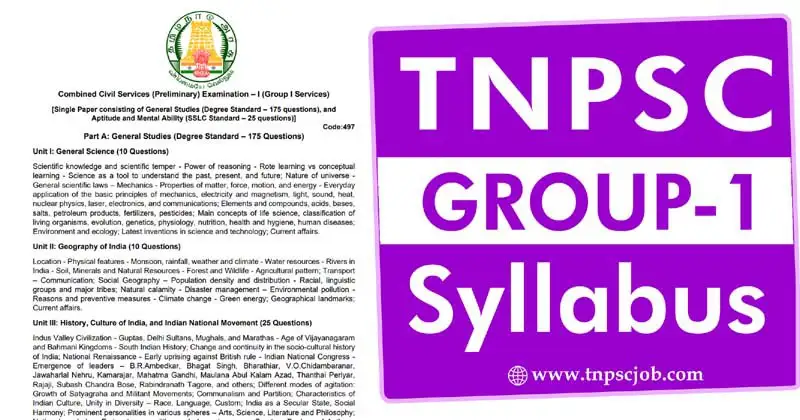
Note Image

We have provided the latest TNPSC Group 1 Syllabus in Tamil for the 2026 exam. The attached syllabus includes the updated exam pattern and important topics covered in each subject. This will be helpful for students who will be appearing for the Group 1 Preliminary Exam on 6th September 2026.

  • TNPSC Group 1 New Syllabus 2026 Published in Tamil and English.

TNPSC Group 1 Syllabus 2026

The Tamil Nadu Public Service Commission (TNPSC) conducts a prestigious recruitment process known as the Combined Civil Services Examination-I (Group 1). This recruitment aims to fill important positions in Tamil Nadu, including Deputy Collector, DSP, Assistant Commissioner, and others. To succeed in the Group 1 exam on your first try, thorough preparation is crucial, with a focus on understanding the Exam Pattern and Syllabus.

Particulars Details
Exam Name CCSE I / Group 1
Post Name Deputy Collector, DSP, Assistant Commissioner
Vacancies 90+
Exam Date 6th September 2026
Exam Stages 3 Stages (Prelims, Mains & Interview)
Exam Duration 3 Hours
Exam Language Tamil and English
Syllabus PDF Download

TNPSC Group 1 Exam Pattern 2026

The table below provides a clear understanding of the TNPSC Group 1 Preliminary Exam Pattern. The Preliminary Exam consists of a single paper with two different sections, namely General Studies and Aptitude & Mental Ability. You are allowed 3 hours to complete the paper.

Prelims Subject No.of Qts Marks
General Studies 175 262.5
Aptitude & Mental Ability 25 37.5
Total 200 300

TNPSC Group 1 Prelims Syllabus 2026

The TNPSC Group 1 Prelims Syllabus 2026 for aspirants in both Tamil and English Medium includes the following chapters:

Part A: General Studies (Degree Standard – 175 Questions)

Unit I: General Science (10 Questions)

Physics

  • Scientific knowledge and scientific temper – Power of reasoning – Rote learning vs conceptual learning – Science as a tool to understand the past, present, and future; Nature of universe – General scientific laws – Mechanics – Properties of matter, force, motion, and energy – Everyday application of the basic principles of mechanics, electricity and magnetism, light, sound, heat, nuclear physics, laser, electronics, and communications;

Chemistry

  • Elements and Compounds, Acids, Bases, Salts, Petroleum Products, Fertilizers, and Pesticides.

Biology

  • Main concepts of life science, classification of living organisms, evolution, genetics, physiology, nutrition, health and hygiene, human diseases
  • Environment and ecology;

Current affairs

  • Latest inventions in science and technology.

Unit II: Geography of India (10 Questions)

  • Location – Physical features – Monsoon, rainfall, weather and climate – Water resources – Rivers in India – Soil, Minerals and Natural Resources – Forest and Wildlife – Agricultural pattern
  • Transport – Communication; Social Geography – Population density and distribution – Racial, linguistic groups and major tribes.
  • Natural calamity – Disaster management – Environmental pollution –
    Reasons and preventive measures – Climate change – Green energy.
  • Geographical landmarks;
  • Current affairs.

Unit III: History, Culture of India, and Indian National Movement (25 Questions)

Indian History

  • Indus Valley Civilization – Guptas, Delhi Sultans, Mughals, and Marathas – Age of Vijayanagaram and Bahmani Kingdoms – South Indian History.
  • Change and continuity in the socio-cultural history of India.
  • National Renaissance – Early uprising against British rule – Indian National Congress – Emergence of leaders – B.R.Ambedkar, Bhagat Singh, Bharathiar, V.O.Chidambaranar, Jawaharlal Nehru, Kamarajar, Mahatma Gandhi, Maulana Abul Kalam Azad, Thanthai Periyar, Rajaji, Subash Chandra Bose, Rabindranath Tagore, and others.

Different modes of agitation:

  • Growth of Satyagraha and Militant Movements; Communalism and Partition; Characteristics of Indian Culture, Unity in Diversity – Race, Language, Custom; India as a Secular State, Social Harmony; Prominent personalities in various spheres – Arts, Science, Literature and Philosophy.

National symbols

  • National symbols – Eminent personalities and places in news – Sports – Books and Authors.

Current affairs

  • Current affairs.

Unit IV: Indian Polity (40 Questions)

  • Constitution of India – Preamble to the Constitution – Salient features of the Constitution
  • Union, State and Union Territory
  • Citizenship, Fundamental Rights, Fundamental Duties, Directive Principles of State Policy
  • Union Executive, Union Legislature – State Executive, State Legislature – Local Governments, Panchayat Raj
  • Spirit of federalism: Centre – State relationships
  • Election
  • Judiciary in India – Rule of Law –
  • Corruption in public life – Anti-corruption measures – Lokpal and Lok Ayukta – Right to Information
  • Empowerment of Women
  • Consumer Protection Forums
  • Human Rights Charter
  • Political parties and political system in India.
  • Current affairs.

Unit V: Indian Economy and Development Administration in Tamil Nadu (50 Questions)

  • Nature of Indian Economy
  • Five-year plan models – an assessment – Planning Commission and Niti Aayog
  • Sources of revenue – Reserve Bank of India – Fiscal Policy and Monetary Policy – Finance Commission – Resource sharing between Union and State Governments – Goods and Services Tax.
  • Structure of Indian economy and employment generation, Land Reforms and Agriculture – Application of Science and Technology in Agriculture – Industrial growth – Rural welfare oriented programmes – Social problems – Population, Education, Health, Employment, Poverty.
  • Human Development Indicators in Tamil Nadu and a comparative assessment across the Country – Impact of social reform movements in the socio-economic development of Tamil Nadu – Political parties and welfare schemes for various sections of people – Rationale behind the reservation policy, and access to the social resources – Economic trends in Tamil Nadu – Role and impact of social welfare schemes in the socio-economic development of Tamil Nadu – Social justice and social harmony as the cornerstones of socio-economic development.

Development Administration in Tamil Nadu

  • Education and health systems in Tamil Nadu.
  • Geography of Tamil Nadu and its impact on economic growth.
  • Achievements of Tamil Nadu in various fields; e-Governance in Tamil Nadu.
  • Public awareness and General administration – Welfare oriented Government schemes and their utility, Problems in public delivery systems.

Current affairs

  • Current socio-economic issues.

Unit VI: History, Culture, Heritage, and Socio-Political Movements in Tamil Nadu (40 Questions)

  • History of Tamil Society, related archaeological discoveries
  • Tamil literature from Sangam age till contemporary times.
  • Thirukkural – Significance as a secular literature – Relevance to everyday life, Impact of Thirukkural on humanity, Thirukkural and universal values – Relevance to Socio-politicoeconomic affairs, Philosophical content in Thirukkural.
  • Role of Tamil Nadu in freedom struggle – Early agitations against British Rule – Role of women in freedom struggle.
  • Evolution of 19th and 20th century socio-political movements in Tamil Nadu – Justice Party, Growth of Rationalism – Self Respect Movement, Dravidian Movement, and principles underlying both these movements.
  • Contributions of Thanthai Periyar and Perarignar Anna.

Part B: Aptitude and Mental Ability (SSLC Standard – 25 Questions)

Unit I: Aptitude (15 Questions)

  • Simplification – Percentage – Highest Common Factor (HCF) – Lowest Common Multiple (LCM) – Ratio and Proportion
  • Simple interest – Compound interest – Area – Volume – Time and Work.

Unit II: Reasoning (10 Questions)

  • Logical reasoning – Puzzles – Dice – Visual reasoning – Alpha numeric reasoning – Number series.

TNPSC Group 1 Syllabus 2026 PDF

For the year 2026, we have provided the TNPSC Group 1 Syllabus in PDF format in both Tamil and English for your convenience. You can download the syllabus materials using the links below:

Gr-1 Syllabus Link Details PDF Link
Group 1 Prelims Syllabus 2025 in Tamil PDF Download
Group 1 Prelims Syllabus 2025 in English PDF Download
Mains Examination New Syllabus 2026 in Tamil Download
Mains Examination New Syllabus 2026 in English Download
Model Question Papers – Download

TNPSC Group 1 Old Syllabus PDF

TNPSC Group 1 Old Syllabus PDF Link
TNPSC Group 1 Prelims Old Syllabus in Tamil Download
TNPSC Group 1 Prelims Old Syllabus in English Download
Tamil Eligibility Test Old Syllabus Download
Mains Examination Old Syllabus Download
Mains Examination Syllabus [Old] Download

Group 1 Syllabus Where to Study

TNPSC Group 1 Mains Exam Pattern 2026

Please find below the TNPSC Group 1 2026 Mains Exam Pattern. It is essential to have a good understanding of the Group 1 Mains Syllabus and Exam Pattern, which is based on the Group 1 Prelims Syllabus. This is because most of the Prelims topics will also be covered in the main examination.

Mains Subject (Degree Standard) Duration Maximum Marks
Paper-I: Tamil Eligibility Test* 3 Hours 100
Paper-II: General Studies I 3 Hours 250
Paper-III: General Studies II 3 Hours 250
Paper-IV: General Studies III 3 Hours 250
Interview & Records   100
Total Marks 950
Note: * Only if 40% marks are secured in Tamil Eligibility Test, Other Competitive Papers will be evaluated.

TNPSC Group 1 Mains Syllabus 2026

தாள் I  – கட்டாயத் தமிழ் மொழி தகுதித் தேர்வு

தாள் I – கட்டாயத் தமிழ் மொழி தகுதித் தேர்வு

தேர்வுத் திட்டம்

  • மொழிபெயர்த்தல்: தமிழிலிருந்து ஆங்கிலத்துக்கு மொழிபெயர்த்தல், ஆங்கிலத்திலிருந்து தமிழுக்கு மொழிபெயர்த்தல்.
  • சுருக்கி வரைதல்.
  • பொருள் உணர்திறன்.
  • சுருக்கக் குறிப்பிலிருந்து விரிவாக்கம் செய்தல்
  • திருக்குறள் தொடர்பான கட்டுரை வரைதல்
  • கடிதம் வரைதல் (அலுவல் சார்ந்தது)
  • தமிழ் மொழி அறிவு

பாடத்திட்டம்

  • தற்கால நிகழ்வுகள்.
  • சமுதாயப் பிரச்சனைகள்
  • சுற்றுச்சூழல் தொடர்பான தலைப்புகள்
  • இந்தியப் பொருளாதரம் தொடர்பான தலைப்புகள்
  • அறிவியலும் தொழில்நுட்பமும்; கலையும் பண்பாடும்;
  • பகுத்தறிவு இயக்கங்கள் – திராவிட இயக்கம், சுயமரியாதை இயக்கம்
  • இக்காலத் தமிழ்மொழி – கணினித் தமிழ், வழக்கு மன்றத் தமிழ், அலுவலக மொழியாகத் தமிழ், புதிய வகைமைகள்;
  • தமிழ்நாட்டின் சமூகப் பொருளாதார முன்னேற்றம் மற்றும் தமிழ்நாட்டு அரசின் நலத்திட்டங்கள் (பெண்கள், விவசாயிகள்…, சமூக நலத்திட்டங்களை நடைமுறைப்படுத்துதலில் சமூக சீர்திருத்த இயக்கங்களின் பங்கு – இட ஒதுக்கீடும் அதன் பயன்களும் – தமிழ்நாட்டின் சமூகப் பொருளாதார வளர்ச்சியில் சமூக நீதி மற்றும் சமூக ஒற்றுமையின் பங்கு.
  • சொந்த வாக்கியத்தில் அமைத்து எழுதுக, பொருள் வேறுபாடு அறிதல்.
  • பிரித்தெழுதுக, எதிர்ச்சொல், எதிர்மறை வாக்கியம், பிழை நீக்கி எழுதுக.
  • திருக்குறளிலிருந்து தலைப்புகள் தொடர்பாக கட்டுரை எழுதுதல்: மதச் சார்பற்ற தனித் தண்மையுள்ள இலக்கியம், அன்றாட வாழ்வியலோடு தொடர்புத் தன்மை, மானுடத்தின் மீதான திருக்குறளின் தாக்கம், திருக்குறளும் மாறாத விழுமியங்களும் – சமத்துவம், மனிதநேயம் முதலானவை; சமூக அரசியல் பொருளாதார நிகழ்வுகளில் திருக்குறளின் பொருத்தப்பாடு, திருக்குறளில் தத்துவக் கோட்பாடுகள்

Paper II – General Studies I (Degree Standard – 250 Marks)

Unit I: Modern History of India and Indian Culture (100 marks)

  • Advent of Europeans – Colonialism and imperialism – Establishment, expansion and consolidation of British Rule
  • Early uprising against British Rule
  • South Indian rebellion 1799 – 1801 A.D. – Vellore rebellion 1806 A.D. – Sepoy mutiny of 1857 A.D.
  • Indian National Movements
  • Moderation, Extremism and Terrorism Movements of Indian Patriotism
  • Significant Indian National Leaders – Rabindranath Tagore, Maulana Abulkalam Azad, Mohandas Karamchand Gandhi, Jawaharlal Nehru, Subhas Chandra Bose, B.R.Ambedkar and Vallabhai Patel
  • Constitutional developments in India from 1773 to 1950
  • Second World War and final phase of independence struggle  Partition of India
  • Role of Tamil Nadu in freedom struggle – Subramanya Siva – Subramania Bharathiyar, V.O.Chidambaranar, C.Rajagopalachariyar, Thanthai Periyar, Kamarajar and others
  • Impact of British rule on socio-economic affairs – National Renaissance Movement – Socio-religious reform movements – Social reform and educational reform acts.
  • Emergence of “Social Justice” Ideology in Tamil Nadu – Origin, Growth, Decay and achievements of Justice Party – Socio-political movements and its achievements after Justice Party.
  • India since Independence – Salient features of Indian culture – Unity in diversity – Race – Language – Religion, Customs and Rituals – India, a Secular State; Organizations for Fine Arts, Dance, Drama and Music
  • Cultural Panorama – National Symbols – Eminent personalities in cultural field
  • Latest historical research developments in Tamil Nadu.

Unit-II: Social Issues in India and Tamil Nadu (100 marks)

  • Population Explosion – Fertility, Mortality – Population Control Programmes – Migration – Poverty – Illiteracy – Dropouts – Right to Education – Women Education – Skill based education and programmes – E-Learning.
  • Child labour and Child abuse – Child Education – Child school dropouts – Child abuse – Laws to protect Child abuse – Child protection and welfare schemes.
  • Sanitation: Rural and Urban Sanitation – Role of Panchayat Raj and Urban development agencies in sanitation schemes and programmes.
  • Women Empowerment: Social justice to women – Schemes and programmes – Domestic violence – Dowry menace – Sexual assault – Laws and awareness programmes – Prevention of violence against women – Role of Government and NGOs in women empowerment – Schemes and Programmes;
  • Social Changes: Urbanization – Policy, Planning and Programmes in India and Tamil Nadu – Comparative study on social and economic indicators – Impact of violence on society – Religious violence – Terrorism and Communal violence – Causes – Steps to control and awareness; Problems of minorities.
  • Human rights issues; Regional disparities in India – Causes and remedies.
  • Social development: Approaches – Models – Policies and programmes – Linkage between education and social development – Community development programmes – Self-employment and entrepreneurship development – Role of NGOs in social development.
  • Education – Health and human development – Health care problems in India – Children, Adolescents, Women and Aged – Health Policy in India – Schemes – Health Care Programmes in India
  • Vulnerable sections of the population: Problems – laws and punishments – Various welfare programmes to vulnerable sections by State, Central Government and NGOs
  • Current Affairs.

Unit III: Ethics and Integrity (50 marks)

  • Ethics and Human Interface: Definition and scope of ethics – Ethics of Indian Schools of Philosophy –
    Ethics of Thirukkural.
  • Kinds of ethics: Intuitionism – Existentialism – Duties and responsibility – Moral judgements – Moral Absolutism – Moral Obligation.
  • Attitude: Its influence and relation with thought and behaviour – Moral and political attitudes; Ethics in public administration: Philosophical basis of governance and probity in Governance – Codes of ethics and conduct: Primary responsibilities of public service professionals – Transparency of information sharing and service delivery – Professional and nonprofessional interaction – Potentially beneficial interaction – Maintenance of confidentiality of records – Disclosure of Information – Boundaries of competence – Consultation on ethical obligation – Ethics and Non-discrimination – Citizen’s Charters – Challenges of corruption – Ethics of public polity determination.

Paper III– General Studies II (Degree Standard – 250 Marks)

Unit I: Indian Polity and Emerging Political Trends across the World affecting India (100 marks)

  • Constitution of India – Historical background – Making of the Indian Constitution – Preamble – Salient features of Indian Constitution – Parts, Articles and Schedules – Amendments
  • Citizenship; Fundamental Rights and Fundamental Duties
  • Directive Principles of State Policy
  • Structure, Power and Functions of Governments: Union Government – Legislature: Parliament – Lok Sabha and Rajya Sabha.
  • Executive: President, Vice-President – Prime Minister and Council of Ministers – Constitutional Authorities
  • Judiciary: Supreme Court – Judicial Review – Judicial activism – Latest Verdicts.
  • State Government – Legislature: State Legislative Assembly – State Legislative Council
  • Executive: Governor – Chief Minister – Council of Ministers.
  • Judiciary: High Court – District Courts – Subordinate Courts – Tribunals.
  • Local Government: Rural and Urban Local Governments – Historical background – 73rd and 74th Constitutional Amendment Acts
  • Union Territories: Evolution – Administration.
  • Federalism: Indian Federal System – Differentiating from other forms of federalism
  • Union – State Relations: Legislative, Administrative and Financial
    relations
  • Indian Administration: Civil Services in India – Historical background – Classification of Civil Services – Central and State Services –Recruitment and Training.
  • Political Parties: National and Regional – Pressure groups – Public opinion – Mass Media – Social Media – Non – Governmental Organizations (NGOs).
  • Administrative Reforms: Central Vigilance Commission – Anti-Corruption measures – Lokadalat – Lokayukta – Lokpal – Ombudsman in India – RTI Act – Citizen’s Grievances and Administrative Reform Commission – Administrative Tribunals.
  • Profile of Indian States: Demography – State Language – Developmental Programmes – e-governance; India and World: India’s foreign policy – India’s relationship with world countries – Defence and National Security – Nuclear Policy – Terrorism – Human Rights and Environmental issues – International Organisations – Pacts and Summits.
  • Current Affairs.

Unit-II: Role and Impact of Science and Technology in the Development of India (100 marks)

  • Science and Technology – Role, Achievements and Developments – their applications and impacts.
  • Elements and Compounds, Acids, Bases and Salts – Oxidation and reduction – Carbon, Nitrogen and their compounds – Chemistry of Ores and Metals – Fertilizers, Pesticides, Insecticides – Polymer and Plastics – Corrosion – Chemistry in everyday life
  • Energy – Renewable and Non-Renewable – Selfsufficiency – Oils and Minerals exploration.
  • Space Research – Nano Science and Technology – Application of Nano-materials.
  • Advancements in the fields of Information Technology – Robotics and Automation – Artificial Intelligence – Mobile Communication.
  • Computer System Architecture, Operating System, Computer Networks, Cryptography and Network security, Relational Database Management System, Software Engineering, Image Processing, Machine Learning.
  • Cropping pattern in India – Organic farming – Agriculture Biotechnology – Commercially available Genetically Modified Crops – Eco, Social impact of Genetically Modified Crops – Intellectual Property Rights, Bio Safety.
  • Floriculture, Olericulture, Pomology and Medicinal Plants, Conventional and Modern Propagation Technique, Glass House –Hydroponics – Bonsai – Garden features and operations – methods to preserve fruits and vegetables.
  • Genetic Engineering and its importance in Agriculture – Integrated farming – Vermiculture.
  • Main concepts of Life Science – the cell – the basic unit of life – classification of living organism – Nutrition and Dietetics – Respiration – Blood and blood circulation – Endocrine system – Excretion of metabolic wastes – Reproductive system – Animals and human-bio communication – Pheromones and allelochemicals – Genetics – Science of heredity – Health and hygiene – Human diseases – Communicable and noncommunicable diseases – Preventions and remedies – Alcoholism and drug abuse – Genetic engineering – Organ transplantation – Stem Cell Technology – Forensic science – Sewage treatment.
  • Government policy – Organisations in Science and Technology – Role and Functions – Defence Research and Development Organisation (DRDO) – Ocean Research and Development – Medical Tourism – Achievements of Indians in the fields of Science and Technology – Latest inventions in Science and Technology.
  • Current Affairs.

Unit t III: Tamil Society – Culture and Heritage (50 marks)

(Candidates may answer the questions in this unit either in Tamil or in English)

  • Origin and Development of Tamilian – Palmleaf Manuscript – Document – Archaeological excavation in Tamil Nadu – Adhichanallur, Arikkamedu, Keeladi, Konthakai, Manalur, Sivakalai; Arts, Science and Culture: Literature, Music, Drama and other arts – Science – Culture (Internal and External).
  • Tamil Society and the condition of business – Sangam age – Medieval age – Modern age
  • Growth of Rationalist – Origin and Development of Dravidian Movements in Tamil Nadu – Their contribution in Socio and economic development.
  • Socio and cultural life of the modern Tamilian: Caste, Religion, Women, Polity, Education, Economics, Commerce and Relationship with other countries – Tamil Diaspora.
  • Development of modern Tamils: Print – Edition – Translation – Film Industries – Computer and Media.

Paper IV – General Studies III (Degree Standard – 250 Marks)

Unit I: General Geography and Geography of India with Special Reference to Tamil Nadu (75 marks)

  • Earth and Universe: Solar System – Atmosphere, Lithosphere, Hydrosphere and Biosphere; India and Tamil Nadu: Location – Physical Divisions – Drainage – Weather and Climate: Monsoon, Rainfall – Natural Resources: Soil, Natural Vegetation, Wildlife – Irrigation and Multipurpose Projects – Mineral Resources – Energy Resources – Agriculture: Crops, Livestock, Fisheries, Agricultural Revolutions – Industries  Population: Growth, Distribution and Density – Migration – Races, Tribes, Linguistics and Religions – Trade – Geo Politics: Border Disputes; Ocean and Sea: Bottom relief features of Indian Ocean, Arabian Sea and Bay of Bengal.
  • Geospatial Technology: Remote Sensing, Geographical Information System (GIS) and Global Navigation Satellite System (GNSS); Map: Locating features and Places.
  • Current Affairs.

Unit-II: Environment, Biodiversity and Disaster Management (75 marks)

  • Ecology: Structure and function of ecosystem – Ecological succession – Ecosystem services – Biodiversity conservation – Biodiversity Types – Biodiversity Hot Spots in India.
  • Biodiversity : Significance and Threats – In-situ and Ex-situ conservation measures – Roles of Convention on International Trade in Endangered Species of Wild Fauna and Flora (CITES), International Union for Conservation of Nature (IUCN) and Convention on Biological Diversity (CBD) – Biodiversity Act.
  • Environmental Pollution and Management: Air, Water, Soil, Thermal and Noise pollution – Pollution Prevention and control strategies – Solid and hazardous waste management – Environmental Standards and Environmental Monitoring – Environmental Impact Assessment (EIA): Steps in EIA process – Environmental Clearance –
    Environmental Auditing.
  • Sustainable Development: Global Environmental Issues and Management – Sustainable Development Goals (SDGs) and Targets – Climate Change – Changes in monsoon pattern in Tamil Nadu, India and Global scenario – Environmental consequences of climate change and mitigation measures – Clean and Green Energy – Paris Agreement – Nationally Determined Contributions (NDCs).
  • Environmental Laws, Policies and Treaties in India and Global scenario – Natural calamities, Manmade Disasters – Disaster Management and National Disaster Management Authority – Sendai framework for Disaster Risk Reduction – Environmental Health and Sanitation.
  • Current Affairs.

Unit III: Indian Economy – Current Economic Trends and Impact of Global Economy on India (100 marks)

  • Features of Indian Economy – National Income – Capital formation – NEP (New Economic Policy) – NITI Aayog (National Institution for Transforming India).
  • Agriculture – Role of Agriculture – Land Reforms – New Agricultural Strategy – Green Revolution – Contract Farming – Minimum Support Price – Price Policy, Public Distribution System (PDS), Subsidy, Food Security – Agricultural Marketing, Crop Insurance, Labour – Rural Credit and Indebtedness – World Trade Organization and Agriculture
  • Industry – Growth ‐ Policy – Role of Public Sector and Disinvestment – Privatisation and Liberalization – Public Private Partnership (PPP) – SEZs (Special Economic Zones) – MSMEs (Micro, Small and Medium Enterprises) – Make in India.
  • Infrastructure in India – Transport System – Power – Communication – Social Infrastructure – Research and Development.
  • Banking and Finance: Banking, Money and Finance – Central Bank – Commercial Bank – Non Banking Financial Institutions – Stock Market – Financial Reforms – Financial Stability – Monetary Policy – Reserve Bank of India and Autonomy.
  • Public Finance – Sources of Revenue – Tax and Non-Tax Revenue – Canons of Taxation – Goods and Service Tax – Public Expenditure – Fiscal Policy – Public Debt – Finance Commission – Fiscal Federalism; Issues in Indian Economy – Poverty and Inequality – Poverty alleviation programmes – Mahatma Gandhi National Rural Employment Guarantee Act – New Welfare Programmes for Rural Poverty – Unemployment – Gender inequality.
  • Inflation – Inflation targeting – Deflation – Sustainable Economic Growth.
  • India’s Foreign Trade – Balance of Payment, Export-Import Policy, Foreign Exchange Market, Foreign Direct Investment.
  • Globalization – Global Economic Crisis – Impact on Indian economy;
  • International Institutions – IMF (International Monetary Fund) – World Bank – BRICS (Brazil, Russia, India, China and South Africa) – SAARC (South Asian Association for Regional Co-operation) –ASEAN (Association of South East Asian Nations).
  • Tamil Nadu Economy and Issues – Gross State Domestic Product – Trends in State’s Economic Growth – Demographic Profile of Tamil Nadu – Agriculture – Contract Farming.
  • Tamil Nadu State Policy on Promotion of Organic Farming – Industry and Entrepreneurship Development in Tamil Nadu – Infrastructure – Power, Transportation systems – Tourism – Health – Eco-tourism – Social Infrastructure – Self Help Groups and Rural women empowerment – Rural Poverty and Unemployment – Regional economic disparities – Local Government – Recent Government welfare programmes.
  • Current Affairs.